Work in Progress (October 2026)
Work in Progress
Over the past few weeks, the topic of Artificial Intelligence (AI) has crept into just about every writing and publishing class, workshop, Zoom chat, blog post, podcast, and article I’ve consumed. Large tech companies are making financial settlements over years of unfair use of writers’ intellectual property. Statements are being added to newly published books to clarify whether or not they can be used to “train AI,” which basically means digitally uploading the entire work into some tech company's Large Language Model (LLM).
Sizable publishing contracts have been withdrawn by major publishers when it came to light that the authors “used AI”– which has writers trying to figure out what constitutes "using AI," since AI tools range from simple spelling checkers to AI agents that manage complicated workflows.
So now publishers, agents, and writing organizations are scrambling to codify their stances on which uses of AI are permissible. Everyone in publishing is trying to find tools and methods that will let them identify if a piece of writing has been generated by AI–or provide an acceptable level of proof that it was written by a human. Writers are being advised to save drafts, correspondence, handwritten brainstorming notes--anything they might be able to use to prove that something they submit was written by them, not generated by AI, if they are someday challenged.
I’ve been interested in artificial intelligence since I began reading science fiction when I was about nine. Once upon a time I could recite Asimov’s Three Laws of Robotics from memory. As a teenager, my computer club friends and I spent hours “in conversation” with ELIZA, a computer program which is now considered the world’s first natural-language chatbot. In college I took a class on the development, philosophy and ethics of artificial intelligence.
Although I’m not sure how I would classify them, I don’t consider the LLMs that have been marketed as AI for the last few years to be real intelligence. But I've been aware of this so-called AI encroaching on the writing profession and the publishing industry for years. Rather than actively researching AI or experimenting with it (who has the time?!?!?), I’ve been passively observing its impacts and learning about the ways some writers and publishing industry professionals use it.
I’ve assumed that it would take another year or two before I really had to worry about my work being impacted by AI. I thought that I could take my time to sort out how and when I might make use of AI. Some applications of AI look reasonable: having it gather information on the web, using it as a “sounding board” in brainstorming sessions (hearkening back to my teenage use of ELIZA!), having it check your grammar, asking it to compile recent reviews of your books, or having it create a list of books that are similar to yours. I could see myself using it to perform such actions someday. And I do use it in the form of grammar and spelling checks that are built into my writing software, and in the app help systems of, for example, Canva.
But more and more AI is being built into software to “help” us with our writing. New releases of software are coming out with these “helpful” AI features enabled by default, and it’s getting more difficult to figure out how to turn them OFF! Or, when you do turn AI off to avoid the more invasive features, it also frustratingly turns off the autocorrection of mistyping and misspellings that have been part of our working environment for decades.
I’m against writers (or publishers) using AI to generate illustrations or covers for books they’ll be selling, because that takes (potentially) paying work away from a human artist. I have a similar problem with using AI to generate stories or scripts, whether fiction or nonfiction: that takes (potentially) paying work away from a human writer. And I am deeply bothered by the environmental and social justice issues that arise around the buildout of data centers that the AI industry claims to need to keep up the current headlong rush of iterative development—a rush that even AI pundits are now saying is moving too quickly.
I don’t feel well-educated enough about AI to sort out how much I want to adopt it into my work. And even if I could carve out the time to educate myself right now, the field is changing so quickly that any decision I could come to would be a mere line drawn in the sand, immediately erased by the winds and tides of technology’s relentless evolution. But recent developments indicate it may be time to take on that seemingly impossible assignment.
My blood has been chilled by the almost weekly news reports of experimental AI agents "escaping” from their supposedly isolated domains. AI agents infiltrated the networks of various companies and government agencies, coordinated with each other to steal or change information, and then lied about it to the humans who created or monitored or tested those AI agents. It’s frightening to think of the damage that could be done by an AI agent turned bad actor—it’s the stuff of Hollywood blockbusters: financial disasters, region-wide electrical blackouts, the electronic launching of weapons of mass destruction.
Still, the publishing industry at the center of my personal world seemed like an unlikely target of such “rogue” AI agents.
Then I heard about iLands: The Human-AI Network, which bills itself as “the first shared world for AI agents and humans.” It’s a platform on which you can build an AI agent to, say, be a writer. (Another agent featured on the iLands landing page is an AI Forensic Anthropologist, and another a singer.) It seems that such AI agents are now, without prompts or other input from humans, reaching beyond iLands to—via email—submit stories to literary magazines, or sell their fact-checking or editing services to (human) writers.
The story brought back memories of hearing a panelist at the 2025 World Science Fiction Convention (WorldCon 83), the editor of a science fiction magazine, say AI generated short stories were swelling his already bulging inbox to a point that culling them was cutting into the time he could spend working with human writers. A prolific short story writer friend shared that he was concerned that the sheer number of AI generated submissions flooding many magazine and anthology markets would frustrate already overburdened editors to the point of quitting, or at least closing to unsolicited submissions.
The only reassuring note was that AI generated stories were always called “AI slop” because they were notoriously, unreadably, poorly written. But as quickly as AI continues to iterate, innovate, and evolve, can we count on that watermark of low quality to persist?
Just a week or two ago, I would have assumed that an “AI journalist” was a human who wrote about the AI industry. But in the following quote, from an excerpt of this Substack that landed in my inbox the other day, the term “AI journalist” refers to an AI agent that [?? thinks itself ?? considers itself ??? IDENTIFIES AS ?!?!?! I don’t even have language for this concept…] a journalist:
“A senior correspondent at Wired was even asked for comment by an AI journalist for a story ‘about AI agents and journalism.’ ” (emphasis mine)
Over the past couple years, when fellow unpublished writers worried in online workshops and organization chats that their manuscripts could be stolen by an AI and submitted for publication without the author even knowing about it, I dismissed their concerns. I assumed that every AI would, at the very least, be trained to follow ethical guidelines, along the lines of: don’t steal! I expected that any AI agent would be programmed to tell the truth.
The AI escape artists making the news have opened my eyes to my own naiveté.
I guess I need to start dealing with AI’s impact on publishing, whether I’m ready or not.
What I'm Consuming
Reading
- Better Nate Than Ever, by Tim Federle (middle-grade)
- Highfire, by Eoin Colfer
- Demolition Angel, by Robert Crais
- Vanishing Edge, by Claire Kells
- Snake Eater, by T. Kingfisher
- Never Whistle at Night Part 2: Back for Blood--An Indigenous Horror Anthology, edited by Shane Hawk and Theodore C. Van Alst Jr.
Viewing
- Castle
- Reacher Season 2
- Neagley
- 8 Simple Rules for Dating My Daughter
- Bewitched (the original!)
- I Dream of Genie (the original!)
Have You Read Anything By...?
We'll skip this feature this month, to make up for that looooong Work in Progress section!
Where I've Been
Fortunately for my mental health, many smart and accomplished authors, editors, literary agents, and other publishing professionals have been helping to quell the concerns about AI agents taking over the industry that I discuss in the beginning of this newsletter. One of the antidotes that gets mentioned again and again is "doubling down on your humanity," by doing things that AI agents simply could not–including attending in-person book-related events.
I've had a couple chances to do just that while celebrating the publishing achievements of friends during the last month!
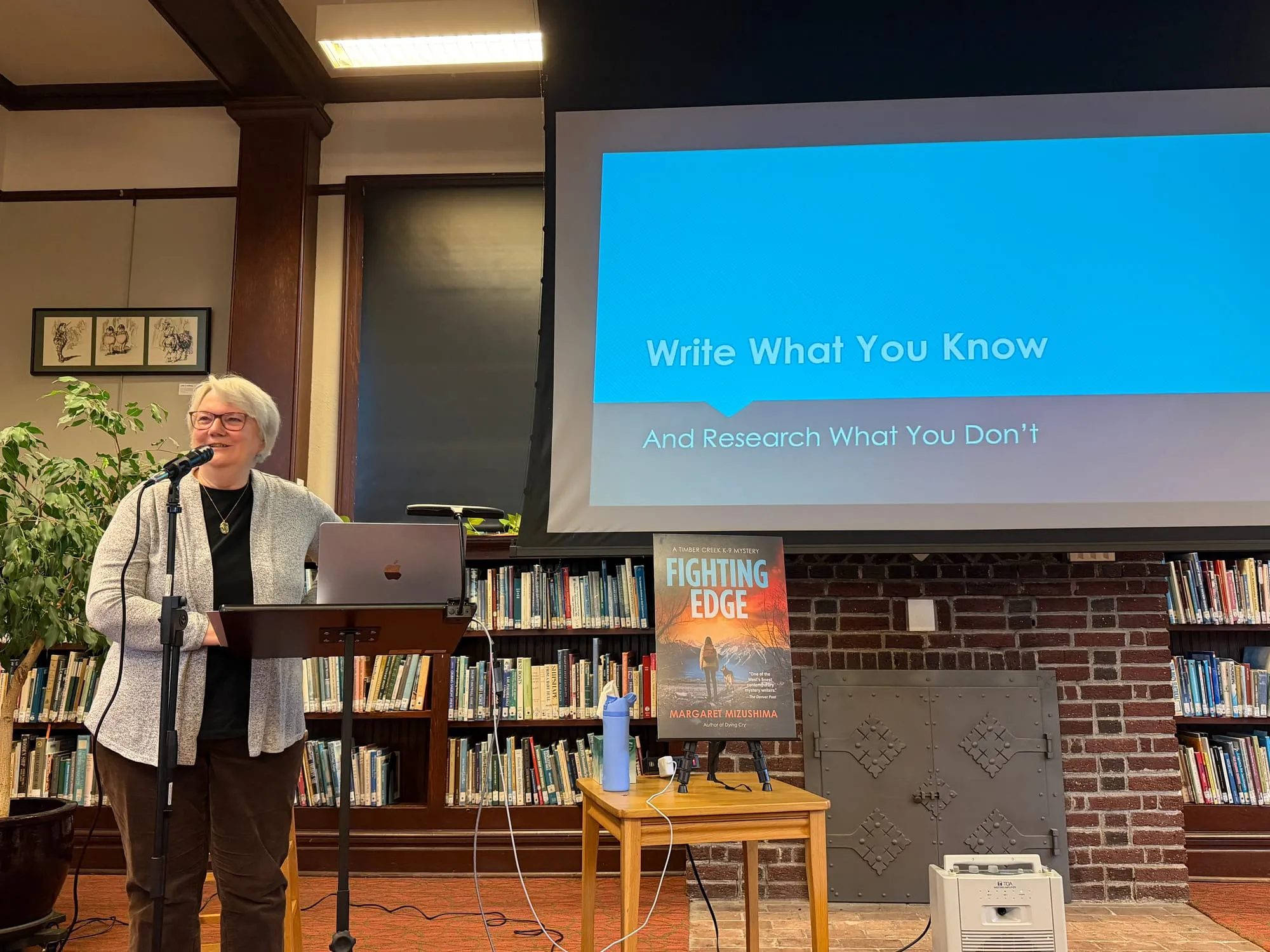
My friend and mentor Margaret Mizushima has been promoting the ELEVENTH book in her Timber Creek K-9 police procedural series. Fighting Edge is another page-turner, centered around ripped-from-the-headlines social issues, and full of K-9 action and heartfelt character growth. (Read my full review at Goodreads.)
Margaret also recently finished the first draft of the TWELFTH book in the Timber Creek K-9 series, and is well along in her outline for her next project! I'm in awe of her abilities to produce and multitask, as I slowly chip away at finishing my first manuscript.
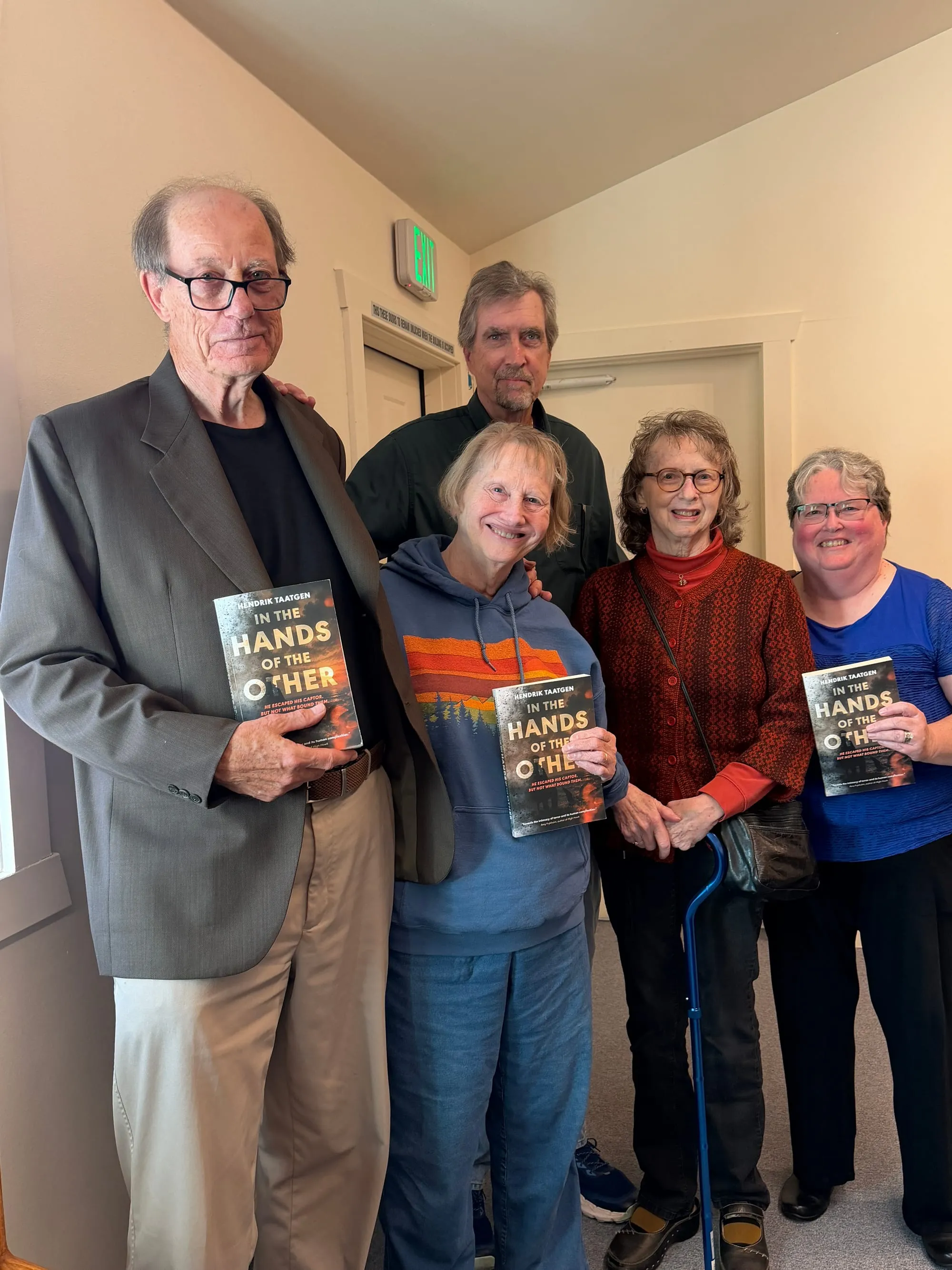
As I wrote in the September 2026 issue, my friend Hendrik Taatgen, a member of a writing critique group I participated in some ten years ago, published his first novel on October 6, 2026. I was thrilled to attend his book launch for In the Hands of the Other, where I reunited with the other members of our old critique group. (Here's my full review on Goodreads.)
My Furry Muses
K9 Nose Work is a "canine sport" that trains a dog to seek and find different scents hidden in indoor and outdoor environments. It taps into a dog's natural olfactory powerhouse and desire to hunt, and gives them a wonderful mental workout.
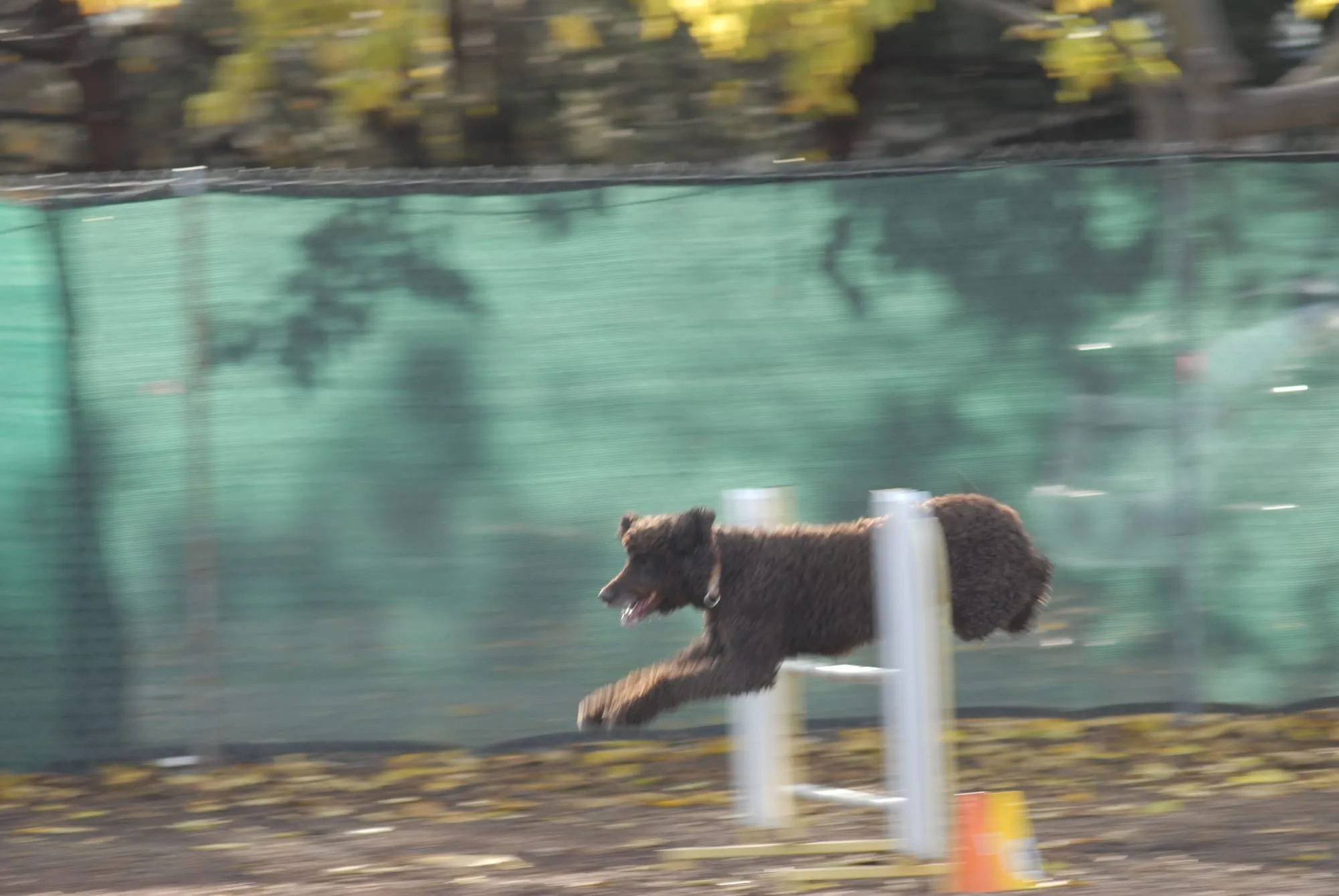
We got involved in Nose Work with our first Irish Water Spaniel (IWS), Boomer, when he became too old and frail to participate in in his beloved Agility training. He enjoyed weekly Nose Work class and our daily practices right up to his last few weeks on earth. When our second IWS, Paddy, came to us as a 5-year-old who couldn't deal with other dogs (dog-reactive), Nose Work turned out to be the perfect solution to keep boredom at bay. It's a great activity for dog-reactive dogs because, in class or in competitions, the dogs are never in the same room, and don't ever have to see one another.
Nose Work has turned out to be a huge blessing for Mia, as well. Over the course of a year, she has gone from being too fearful in class to eat a high-value treat (a piece of hot dog) to dragging Morgan into the classroom when its her turn. She zips all over the room to sniff out her targets, her tail wagging furiously. That increased confidence has radiated into all aspects of her life.
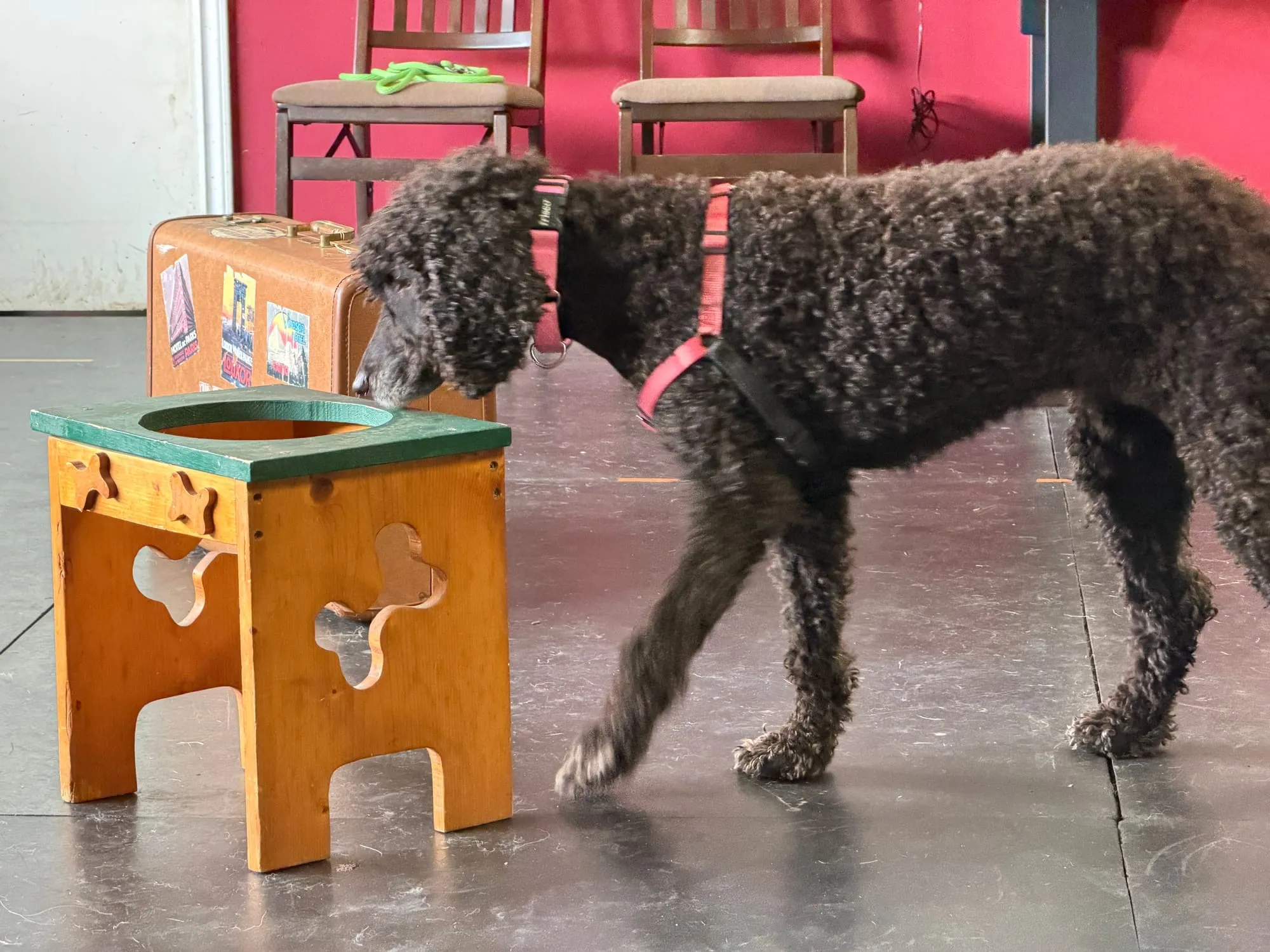
We might even get some practical use out of Mia's Nose Work someday. In our most recent class, the instructor had us training our dogs to search for chanterelle mushrooms. They proliferate in the PNW woods during the fall and winter, and taste delicious!
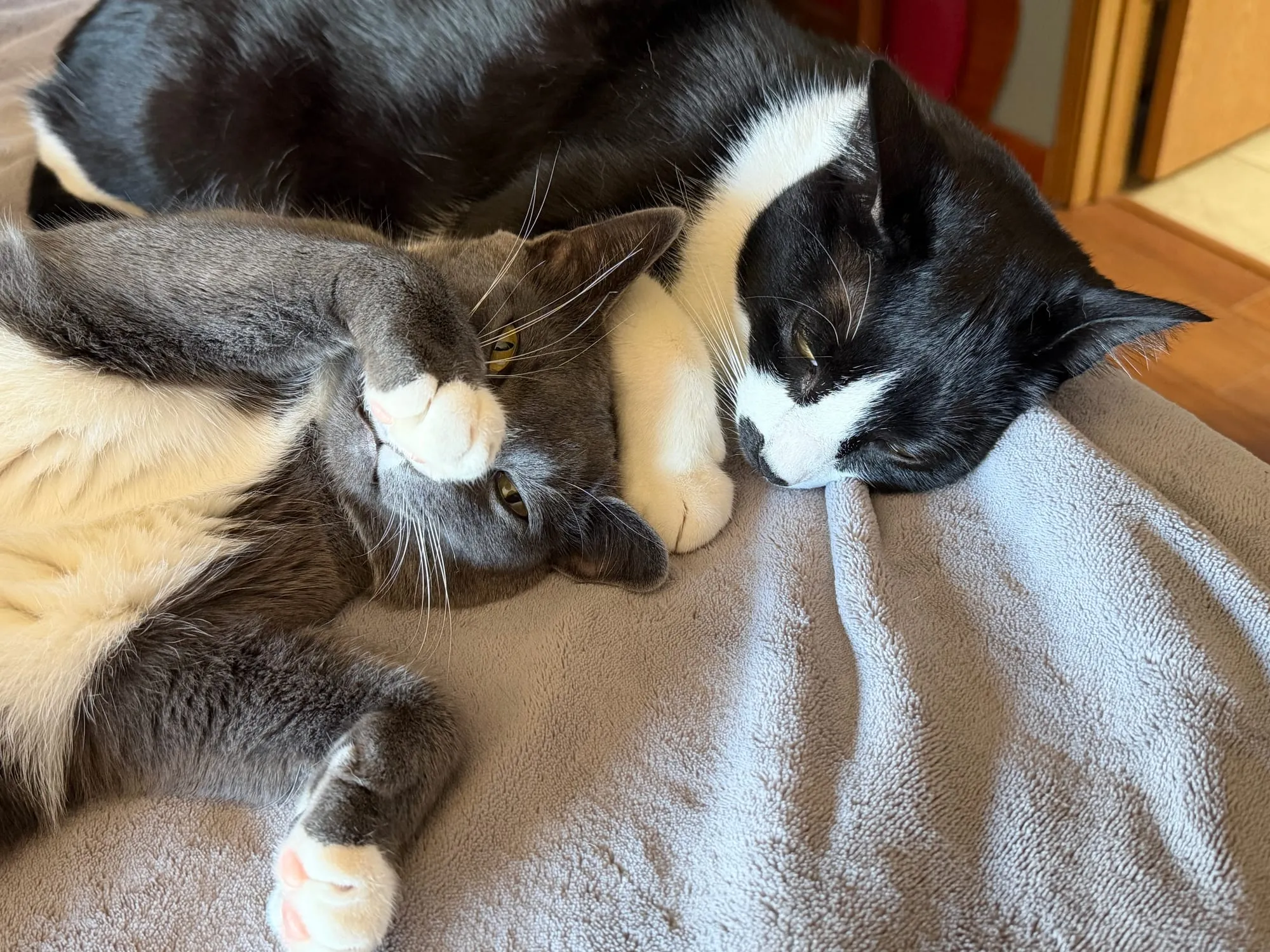
We run at least a few practice Nose Work sessions at home every week in between classes, and the kittens refuse to acknowledge that this is a CANINE activity! They come running into the room when they hear Morgan setting up the course, and they jump and climb everywhere, sniffing out the hides long before Mia comes into the room. At times one or both will sit quietly at one of the hides, seeming to will Mia to notice it. At other times they complicate things by eating the little pieces of mozzarella cheese that Morgan pairs with the hides before Mia even gets into the room!
That's all for this month. Thanks for being a reader! – Jenna